Quick Facts
- Oldest Service: ICQ, launched in 1996 and active until 2024.
- Peak Popularity: MSN Messenger reached a massive milestone of more than 330 million monthly active users.
- Cultural Legacy: Popularized early digital shorthand like A/S/L and the concept of status updates via away messages.
- Transition: Most defunct messaging platforms were eventually absorbed by social media giants or transitioned into mobile-first services like Skype.
- Nostalgia Tech: Modern server emulators now allow users to experience these retro interfaces on Windows 11.
- Data Recovery: Retrieving chat history from these services is largely impossible unless logs were saved locally on old hard drives.
Revisit the era of dial-up connections and A/S/L as we rank the legendary old messaging apps that defined a generation. Iconic old messaging apps from the late 1990s and early 2000s include AOL Instant Messenger (AIM), MSN Messenger, and Yahoo Messenger. These platforms defined early digital communication for millennials by introducing features like away messages, buddy lists, and emoticons. Other influential but defunct services include ICQ, which pioneered mass adoption, and MySpaceIM.
AOL Instant Messenger (AIM): The King of the Away Message
If you grew up in the late 90s, the sound of a squeaky door opening was the soundtrack to your social life. AOL Instant Messenger, or AIM, was the undisputed heavyweight champion of early 90s instant messengers in North America. At its height, it commanded a 52% market share, becoming the primary way an entire generation learned to communicate without looking someone in the eye. It was more than just a chat tool; it was a cultural phenomenon that introduced the world to the Buddy list and the high-stakes drama of the profile bio.
The most enduring legacy of AIM was undoubtedly the away messages. Long before we had Facebook statuses or Instagram Stories, we had these short, often cryptic text snippets that told our friends exactly what we were doing—or, more accurately, how we wanted them to perceive our mood. Whether it was a profound lyric from a pop-punk song or a simple "brb, dinner," these statuses were our first foray into digital identity curation. It was also the birthplace of ubiquitous Internet slang and the legendary icebreaker A/S/L (Age/Sex/Location), which served as the standard greeting in public chat rooms.
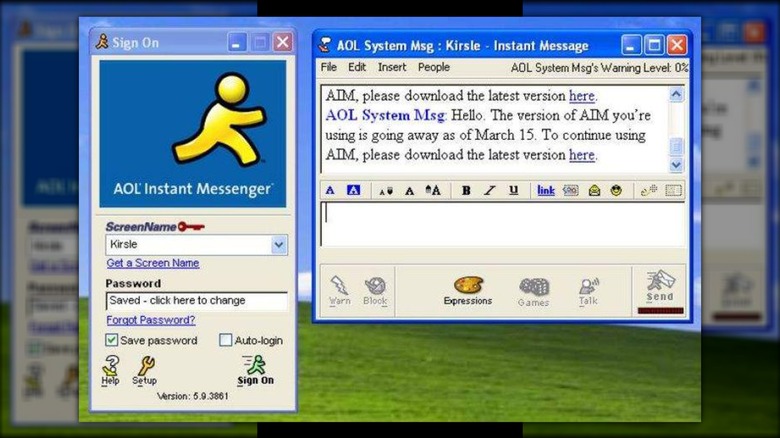
When AIM officially shut down in 2017, it felt like the end of an era. The iconic Running Man logo was retired, but the communication habits it instilled—like real-time communication and abbreviated language—remain the backbone of how we interact today.
MSN Messenger: The Era of 'Nudging' and Custom Emoticons
While AIM ruled the United States, MSN Messenger (later Windows Live Messenger) dominated the global stage. Integrated directly into the Windows operating system, it became a staple for millennials who spent their afternoons after school staring at a bulky monitor. This platform took the foundation laid by its predecessors and added a layer of sensory overload that we still talk about today. MSN’s role in defunct messaging platforms is defined by its peak reach, having more than 330 million monthly active users in June 2009 before Microsoft transitioned users to Skype in 2013.
The most infamous feature was the Nudge. If a friend wasn't replying fast enough, you could send a Nudge that would shake their entire chat window accompanied by a loud, jarring sound. It was the ultimate "pay attention to me" tool. MSN also pioneered the use of custom emoticons, allowing users to replace specific words with tiny, often animated icons. This turned every sentence into a colorful, albeit sometimes unreadable, mosaic of personality.
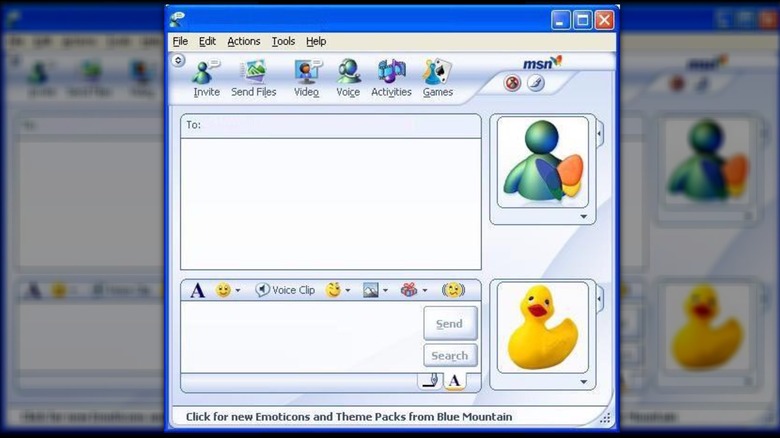
Comparing old messaging apps features like buzz and nudge shows how competitive these platforms were for user engagement. MSN also introduced the "What I'm Listening To" status, which automatically displayed your Windows Media Player tracks, giving everyone a glimpse into your questionable musical tastes.
Yahoo! Messenger: Buzzing and IMVironments
Yahoo! Messenger offered a distinct flavor of digital nostalgia. Launched in 1998, it survived for an impressive 20 years before finally closing its doors in 2018. It was particularly beloved for its Yahoo! Chat rooms, where you could meet strangers based on interests ranging from anime to financial investing. It felt like a massive, global digital lounge that never closed.
The platform’s answer to the nudge was the Buzz button. While similar in function, the Buzz felt slightly more aggressive, designed to cut through the noise of a busy desktop. Yahoo also experimented with IMVironments—themed chat backgrounds that could change based on the conversation or seasonal events. These features made Yahoo! Messenger feel like a more "visual" experience compared to the utilitarian design of other old messaging apps.
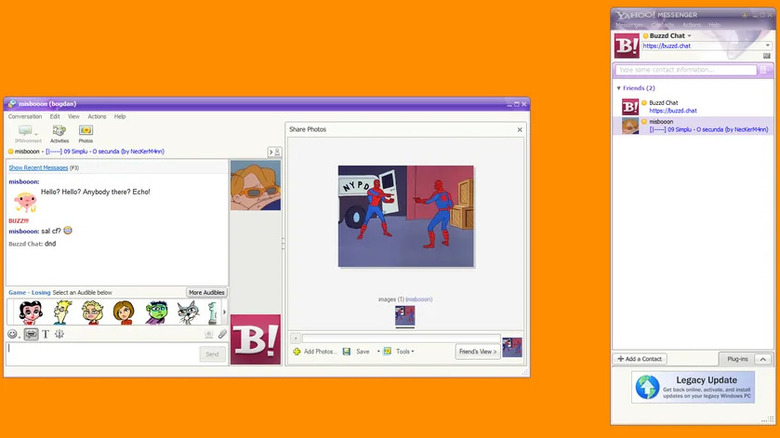
Today, many former users face the frustration of retrieving photos from defunct yahoo messenger accounts. Because Yahoo completely overhauled its infrastructure multiple times before shutting down, most of those old memories are locked away. Unless you were diligent about saving files to your local hard drive, those pixelated webcam photos from 2004 are likely gone forever.
ICQ: The Pioneer of the Buddy List (1996–2024)
To understand the history of instant messaging, you have to go back to ICQ. Developed by the Israeli company Mirabilis in 1996, it was the first platform to achieve massive global adoption. Instead of usernames, ICQ assigned each user a User Identification Number (UIN). If you were an early adopter, having a five- or six-digit UIN was a massive badge of "internet cool."
ICQ was famous for its typewriter-style sound effects and the iconic Uh-Oh! notification that played whenever a new message arrived. It was a product of the dial-up connection era, where every bit of data was precious. ICQ survived much longer than its contemporaries, only officially shutting down in June 2024. This nearly 30-year run makes it a cornerstone of digital history, serving as the functional blueprint for modern apps like WhatsApp and even Tencent's QQ.
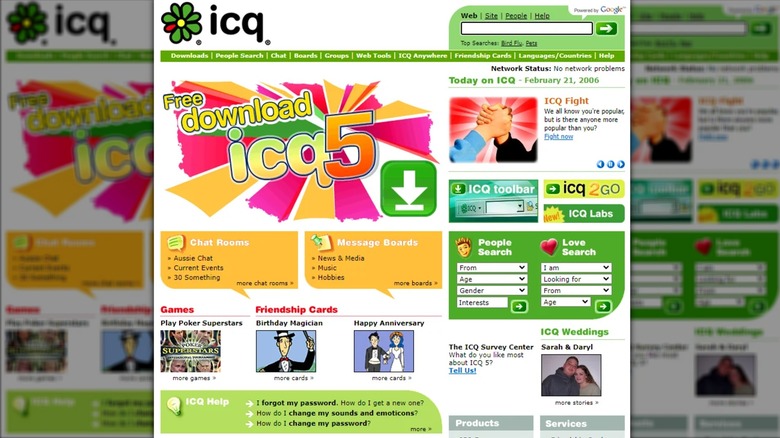
For those looking to relive their youth, knowing how to access old icq chat history is a common request. Unfortunately, as with other defunct services, unless you have the original "New ICQ" or "ICQ99" folders on an old hard drive, the server-side data has been wiped. ICQ's demise marks the final chapter for the original big four of the 90s instant messengers.
BlackBerry Messenger (BBM): Before WhatsApp Ruled the World
While the other apps on this list were born on the desktop, BlackBerry Messenger (BBM) was the king of the mobile-first transition. It turned the BlackBerry phone into a must-have device for teenagers and professionals alike. Before we had "blue bubbles" or "read receipts," we had the "D" and "R" status indicators on BBM.
BBM introduced the concept of the PIN, a unique alphanumeric code that allowed you to add friends without sharing your phone number. This provided a level of privacy that felt revolutionary at the time. It fostered a sense of exclusivity; if you had a BBM PIN, you were part of a specific club. The real-time communication provided by BBM, including the "typing" indicator, set the standard for every mobile messaging app that followed.
As the world shifted toward full-touchscreen smartphones, the physical keyboard of the BlackBerry became a relic, and BBM eventually lost its grip on the market. However, the influence of its feature set is visible in almost every modern encrypted chat application we use today.
How to Revisit the Past: Legacy Emulators and Archives
For many millennials, the loss of these platforms feels like losing a piece of their childhood home. While the official servers are dead, the community has stepped in to preserve this history. Projects like Escargot allow users to engage in a bit of digital nostalgia by providing custom servers for old versions of MSN and AIM.
If you are interested in setting up old messaging apps on modern windows, these server emulators are your best bet. They replicate the original login protocols, allowing the software to function as it did in 2003. You can even hear those classic notification sounds on Windows 11.
| App | Launch Year | Shutdown | Key Legacy Feature |
|---|---|---|---|
| ICQ | 1996 | 2024 | UIN (User Identification Numbers) |
| AIM | 1997 | 2017 | Away Messages & Buddy Lists |
| Yahoo! | 1998 | 2018 | IMVironments & Public Chat Rooms |
| MSN | 1999 | 2013 | The Nudge & Custom Emoticons |
| BBM | 2005 | 2019 | PIN-based Privacy & Read Receipts |
Regarding the timeline of defunct instant messaging platforms 1990-2026, we are currently in a "preservation phase." While most services ended their official runs by 2020, community-led projects are expected to keep these interfaces alive for researchers and nostalgia-seekers through 2026 and beyond. However, don't expect to find your old logs; unless you manually backed up your chat history to a text file or XML log decades ago, those conversations are now part of the digital ether.
FAQ
What were the most popular messaging apps in the early 2000s?
The early 2000s were dominated by AIM in the United States, while MSN Messenger (Windows Live Messenger) was the global leader. Yahoo! Messenger was also a major player, particularly for users who enjoyed themed chat rooms and integrated web services. ICQ remained popular in Europe and parts of Asia during this period as well.
Are any old messaging apps still active today?
Most of the legendary "big four" are now defunct. ICQ was the last to go, shutting down in June 2024. While the original services are no longer active, some have been rebranded or integrated into other tools. For example, MSN's infrastructure was merged into Skype, and Yahoo! replaced its legacy messenger with a completely different mobile-focused app before eventually discontinuing that too.
How can I recover messages from a discontinued chat app?
Direct recovery from official servers is generally impossible because the servers for MSN, Yahoo, and AIM have been physically decommissioned or wiped. Your only hope of recovering messages is to find the original computer you used and check for local log files. Apps like MSN often saved chat history in "My Documents" under a folder called "My Received Files" or "Chat Logs."
Why did many early instant messaging services shut down?
The primary reason was the shift from desktop computers to mobile smartphones. Apps like WhatsApp, iMessage, and Facebook Messenger integrated more seamlessly with mobile operating systems and phone contacts. Additionally, the rise of social media platforms meant that "instant messaging" became a feature of a larger site rather than a standalone application.
What happened to the chat history from old messaging platforms?
When companies like AOL or Yahoo shut down their messenger services, they typically provided a grace period of a few months for users to download their data. Once those deadlines passed, the data was deleted from their servers to save on storage costs and to comply with modern privacy regulations like GDPR.
Are there any modern apps that look like retro messaging services?
Yes, several community projects exist to satisfy digital nostalgia. Programs like Escargot and Nimbuzz have attempted to recreate or support retro chat protocols. Additionally, modern apps like Discord allow for significant UI customization, and some users create "skins" that make the interface look exactly like the classic AIM or MSN windows.