Quick Facts
- Era Focus: 1980-1989
- Core Transition: Analog-to-digital shift
- The MVP: IBM Personal Computer (1981)
- Standard Printer: Dot Matrix and the HP LaserJet (1984)
- Data Storage: 5.25-inch and 3.5-inch floppy disks
- Communication: Pagers and Fax machines
The 1980s office technology landscape was a bold mix where analog-to-digital transition defined the daily workflow. From clacking typewriters to the rise of MS-DOS, these vintage office machines paved the way for modern efficiency by moving computing away from large mainframes and into individual workstations.
The IBM PC: The Microprocessor Revolution
If you walked into a corporate headquarters in 1980, the concept of a computer on every desk was still a futuristic dream. Most computing power was locked away in air-conditioned rooms housing massive mainframes. That changed on August 12, 1981, with the release of the IBM Model 5150. As an editor who has spent decades tearing down laptops and benchmarking CPUs, I look back at the IBM PC as the definitive turning point for computing hardware and software standards.
The IBM PC was not the first personal computer, but it was the one that gave the industry a professional backbone. Its open architecture was a masterstroke, allowing other manufacturers to create compatible clones. This led to a massive expansion of the market, where the IBM PC and its compatibles surpassed a 50% share of the personal computer market by 1986. This standardization meant that for the first time, a spreadsheet created in one office could reasonably be expected to open in another.
Behind the beige plastic lived the Intel 8088 microprocessor, running at a modest 4.77 MHz. While that sounds primitive today, it was the engine of the microprocessor evolution that brought MS-DOS into the mainstream. Businesses quickly realized that essential software for 1980s ibm pc business operations, like Lotus 1-2-3 for spreadsheets or dBase for databases, could handle tasks in minutes that previously took accounting departments days to calculate by hand.
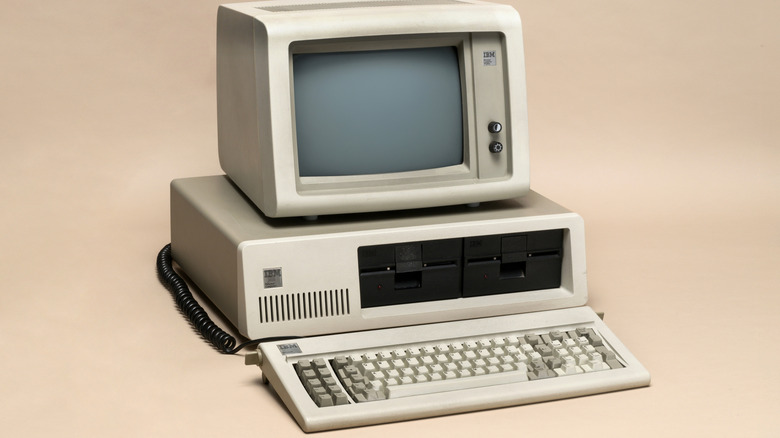
This era also saw a massive surge in hardware adoption. In the United States, annual personal computer shipments skyrocketed from 327,000 units in 1980 to approximately 1.3 million units by 1985. This growth fundamentally shifted the workflow, forcing professionals to learn how to handle Floppy disks and navigate a command-line interface before the Graphical User Interface became a corporate standard.
Electronic Typewriters: The Last Stand of Analog
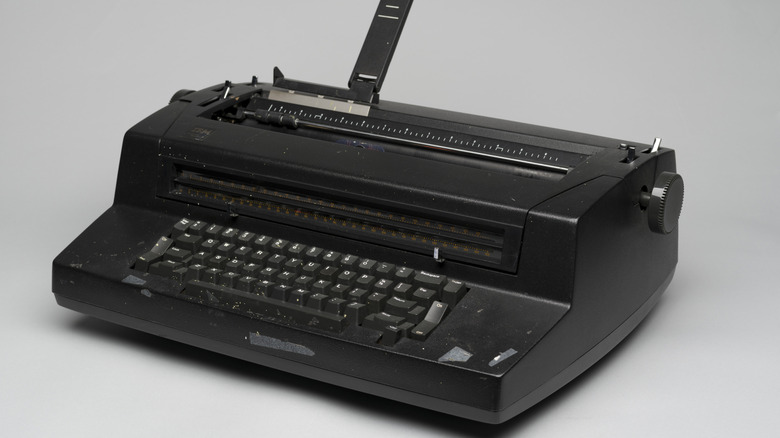
While the PC was the rising star, 1980s business equipment still leaned heavily on the typewriter. However, these weren't your grandfather’s manual machines. The 1980s represented the peak of the electronic typewriter, a hybrid device that bridged the gap between mechanical striking and digital word processing.
The IBM Selectric series, particularly the later electronic models, featured "memory" that allowed users to store a few lines of text or even entire pages. For a secretary in 1984, the ability to backspace and have the machine physically lift the ink off the page with a correction tape was nothing short of magic. It was the precursor to the "delete" key we take for granted.
| Feature | 1970s Manual Typewriter | 1980s Electronic Typewriter |
|---|---|---|
| Correction | Correction fluid (Wite-Out) | Lift-off correction tape |
| Storage | Physical Paper | Internal memory (limited) |
| Mechanism | Mechanical linkage | Microprocessor-controlled |
| Speed | Limited by finger strength | Up to 20-30 characters per second |
Even today, there is a niche movement focused on restoring vintage electronic typewriters for daily office use. There is something tactile and focused about these machines. For those of us who struggle with the distractions of modern notifications, many writers are rediscovering how to use electronic typewriters for distraction free writing. They offer the satisfying "thwack" of a daisy wheel hitting paper without the temptation of a browser tab.
The Fax Machine: Pre-Internet Instant Communication
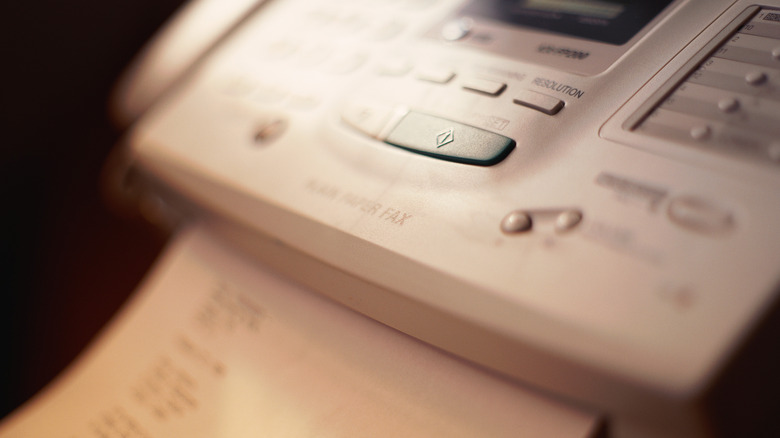
In the mid-1980s, if you needed to send a contract from New York to London instantly, you didn't use email—you used the "telecopier," or what we now know as the fax machine. This era of telecommunications history was defined by the transition from the slow, expensive overnight courier to the screaming, whirring sounds of a thermal transfer fax.
The adoption was explosive. By the mid-80s, the fax machine became a ubiquitous piece of 1980s business equipment. It worked by scanning a document, converting the image into audio tones, and "playing" those tones over a standard phone line to a receiving machine. The receiver would then decode those sounds and use a thermal print head to burn the image onto a roll of chemically treated paper.
Working with an 80s fax machine was a sensory experience. The paper was slick, slightly shiny, and had a habit of curling into a tube as soon as it left the machine. The text was often grainy, and if you left a fax in a hot car, the entire page might turn black due to the heat-sensitive nature of the paper. Despite these quirks, the fax machine provided the first real taste of a globalized, instant business world.
Photocopiers: From Specialty Room to Desktop Utility
Before the 80s, making a copy often involved a trip to a dedicated "copy room" managed by a specialist or using messy carbon paper. The 1980s changed that by miniaturizing the technology. Companies like Minolta and Xerox began producing "desktop" copiers, bringing document reproduction directly into the workstation area.
Machines like the Minolta EP 300 introduced micro-toning technology, which improved the crispness of the copies. The 80s also saw the introduction of features we now consider standard, such as automatic document feeders and basic collating/stapling functions. This miniaturization was a key part of the retro workplace technology trend that prioritized convenience.
The physical process involved electrostatic charging, where a light-sensitive drum would catch toner and heat-press it onto paper. This gave 80s offices a very specific smell—a mix of ozone and heated plastic—that anyone who worked in that era will never forget. As desktop publishing began to take root toward the end of the decade, the ability to quickly duplicate high-quality layouts became essential for marketing and internal communications.

Dot Matrix Printers: Impact Printing and Noisy Progress
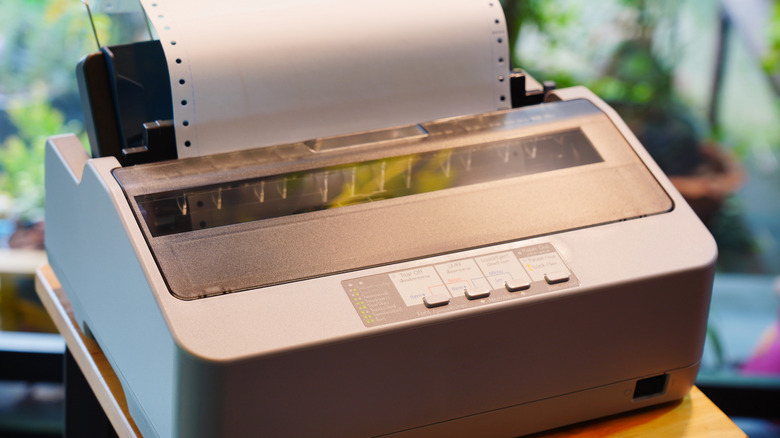
If you close your eyes and think of 80s office technology, you can probably hear the high-pitched "ee-ee-ee" sound of a dot matrix printer. Unlike the silent inkjet or laser printers of today, dot matrix printers were devices of impact printing. A print head containing a vertical column of pins would strike an ink-soaked ribbon against the paper, much like a typewriter, but building characters out of individual dots.
These machines almost exclusively used continuous form paper—those long reams of paper with perforated holes on the sides that fed into a tractor system. It was rugged, reliable, and loud. For accounting departments, these were indispensable because the physical strike of the pins allowed them to print through multiple layers of carbon-copy forms, something a modern laser printer cannot do.
Pro Tip: For those maintaining dot matrix printers for vintage hardware enthusiasts, the biggest challenge today isn't the hardware, but finding fresh ribbons. Many collectors now "re-ink" their old ribbons using stamp pad ink to keep the 9-pin and 24-pin heads flying.
However, the high-end landscape changed in 1984 with the introduction of the HP LaserJet. It set a new standard for professional quality, offering 8ppm (pages per minute) and 300 dpi resolution. While it cost nearly $3,500 at launch, it signaled the beginning of the end for the noisy dot matrix in professional settings.
The Cabling Crisis: Reshaping Office Furniture
The rapid influx of all this 80s office technology created a physical problem: where do you put the wires? Most office desks in 1980 were designed for a telephone and a notepad. Suddenly, employees had a heavy CRT monitor, a system unit, a keyboard, a printer, and perhaps a dedicated modem—all requiring power and data cables.
This led to what designers called the "Cabling Crisis." Heavy, solid-wood C-frame desks began to disappear, replaced by retro office furniture design and 80s computer desk layouts that featured "cable grommets" and hollow legs to hide the "spaghetti" of wires.
Office ergonomics also became a topic of conversation for the first time. The bulky nature of 1980s business equipment meant that desks had to be deeper to accommodate the 15-inch deep CRT monitors, and "keyboard trays" were bolted onto the undersides of desks to keep users' wrists at a comfortable height. It was a decade where the physical workspace was literally rebuilt to accommodate the digital revolution.
FAQ
What common technology was used in offices in the 1980s?
The 1980s office was a hybrid environment. Common tools included the IBM PC or its clones, electronic typewriters like the IBM Selectric, fax machines for communication, and dot matrix printers for generating reports. For data storage, floppy disks were the standard, and photocopiers were used for document reproduction.
What was the most popular office computer in the 80s?
The IBM Personal Computer (and the subsequent IBM PC/XT and PC/AT) was the most popular and influential office computer. Its open architecture led to the rise of PC clones from companies like Compaq and Dell, which helped the PC platform dominate over 50% of the market by the mid-80s.
How did offices communicate before widespread internet?
Before the internet, offices relied on landline telephones, pagers, and fax machines. For written correspondence that didn't need to be instant, the postal service and overnight couriers like FedEx were essential. Internal communication often happened through physical "interoffice memos" delivered by hand or through a pneumatic tube system in some large buildings.
When did fax machines become standard in the workplace?
Fax machines began to see rapid adoption in the early to mid-1980s. By 1987-1988, they were considered an absolute necessity for any business engaged in national or international trade, as they allowed for the near-instant transmission of signed documents.
Did offices still use typewriters in the 1980s?
Yes, typewriters remained very common throughout the 1980s, especially for quick tasks like filling out forms or typing envelopes. However, they evolved into electronic typewriters with digital displays and internal memory, functioning more like dedicated word processors than traditional mechanical machines.
How did people store files and data in 80s offices?
Data was primarily stored on floppy disks. At the start of the decade, the 5.25-inch floppy was the standard, but it was gradually replaced by the more durable 3.5-inch floppy disk by the late 80s. Hard drives were available but were extremely expensive and usually had capacities of only 10MB to 20MB.
The 1980s was an era of noisy progress and incredible innovation. While we might look back and laugh at the "cabling crisis" or the grainy output of a fax machine, these vintage office machines were the foundation of everything we use today. Comparing 80s office tech efficiency vs modern digital tools shows how far we've come, but it also reminds us of a time when every piece of hardware felt like a revolutionary step forward.
What’s your favorite piece of retro tech? Whether it's the satisfying clack of a mechanical keyboard or the smell of a fresh photocopy, share your 80s office memories with us below!