Quick Facts
- Keynote Era: Nvidia is pivoting from Information AI to Physical AI, moving beyond text generation into Vision-Language-Action models.
- RTX Spark: A dedicated superchip for laptops with 70 billion transistors delivering 1 petaFLOP of AI compute for local agentic workflows.
- DLSS 4.5: Scheduled for August 2026, adding spatial awareness and ray reconstruction to help AI agents navigate virtual and real environments.
- Cosmos 3: An open omnimodel foundation that translates multimodal sensor data into physics-based trajectories for robots and vehicles.
- Isaac GR00T: A standardized humanoid robot reference design powered by the Jetson Thor module to accelerate the $50-80 trillion robotics market.
- Alpamayo 2 Super: A 32-billion-parameter reasoning model designed for the autonomous driving sector to provide human-like decision-making.
Physical AI refers to artificial intelligence designed to perceive, reason, and interact with the physical world. At Computex 2026, Nvidia introduced Cosmos 3, an open omnimodel that translates multi-modal data such as video and sound into physical actions. This foundation model uses reasoning and generation transformers to help robots and autonomous vehicles understand spatial relationships and predict trajectories, facilitating real-world generalization even with limited training data.
RTX Spark Superchip: The Local Agent Hub
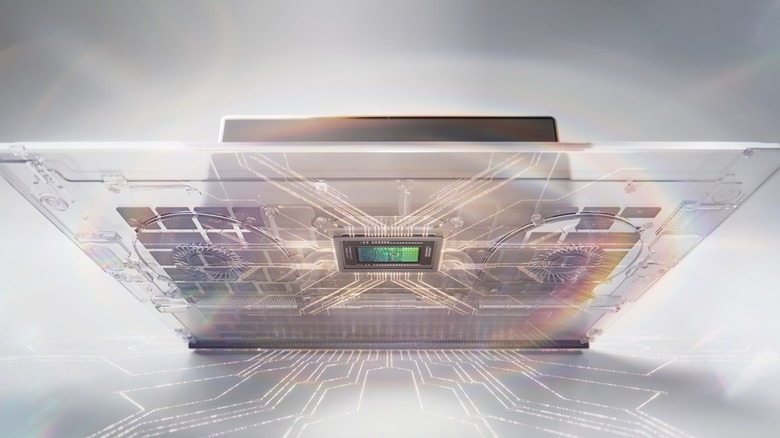
For years, we’ve relied on the cloud to handle the heavy lifting of large language models. But as we move toward a world of personal AI agents that need to see what's on our screens and hear our surroundings in real-time, the latency of the cloud just doesn't cut it. Enter the Nvidia RTX Spark superchip. This isn't just another incremental GPU update; it is a fundamental redesign of silicon for edge inference.
The RTX Spark superchip features 70 billion transistors and delivers up to 1 petaFLOP of AI compute performance to power localized AI agents on Windows laptops. By moving the reasoning engine directly onto the device, Nvidia is solving the privacy and latency issues that have plagued early agentic AI. This chip allows for a high-performance local version of a vision-language-action model, meaning your laptop can "see" a complex CAD file and "act" by suggesting structural optimizations without ever sending a packet of data to a remote server.
From a builder's perspective, the Spark superchip represents the pinnacle of power efficiency for mobile workstations. Instead of draining the battery to maintain a constant handshake with a data center, the local inference capabilities allow for persistent, low-power background reasoning. This is the hardware required for the next generation of physical ai where the digital and physical workflows overlap on your desk.
Hardware Requirements:
- System: Windows 12+
- RAM: 64GB LPDDR6 minimum for 70B parameter models
- Interface: PCIe 6.0 compatible architecture
DLSS 4.5: Bridging Graphics and Spatial Intelligence
We usually think of DLSS as a way to squeeze more frames out of Cyberpunk, but at Computex 2026, Jensen Huang reframed neural rendering as a tool for spatial intelligence. DLSS 4.5, launching in August 2026, introduces a massive evolution of ray reconstruction. While previous versions focused on cleaning up visual noise, DLSS 4.5 creates a 3D understanding of the scene that can be shared with an AI agent.
For gamers, this means 100+ fps at 1440p with full path tracing on mid-range hardware. For the broader world of physical ai nvidia development, it means that an AI agent playing a game or navigating a digital twin can use the internal "spatial awareness" data of the DLSS pipeline to understand depth and object density. This bridges the gap between seeing a pixel and understanding a physical object.
One of the coolest dlss 4.5 ray reconstruction features is how it handles moving objects. By predicting where a physical object should be based on physics-based prediction, it reduces ghosting while simultaneously providing a trajectory map for any embodied AI operating within that environment. This is neural rendering with a purpose beyond aesthetics.
Alpamayo 2 Super: The Reasoning Driver
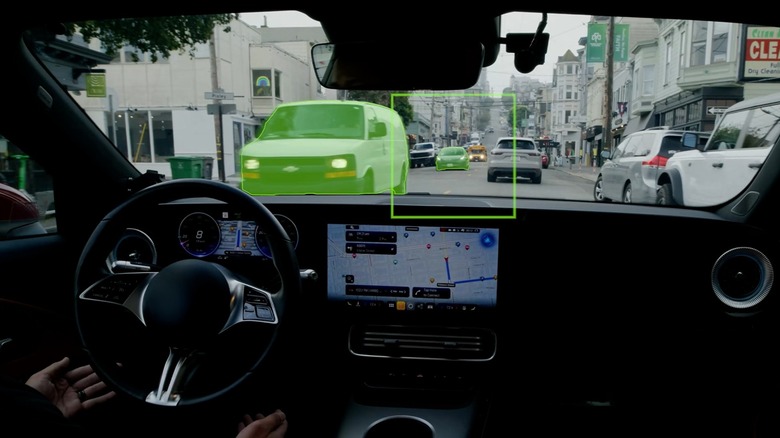
The autonomous driving world has hit a plateau with traditional "if-then" programming. Nvidia's solution is the Alpamayo 2 Super, a 32-billion-parameter reasoning model built for the Drive Hyperion ecosystem. This is a prime example of physical ai examples currently hitting the road. Instead of just reacting to a stop sign, the Alpamayo 2 Super model uses human-like perception to understand why a pedestrian might be stepping into the street.
This model provides the computational power necessary for real-time spatial intelligence. It doesn't just see a "blob" in the road; it reasons that the blob is a ball, and a ball is usually followed by a child. This level of physical ai reasoning works by utilizing massive amounts of synthetic data training through Nvidia's AlpaGym, allowing the car to experience millions of dangerous scenarios in a safe, simulated environment before ever turning a wheel on a city street.
The hardware side of this is equally impressive. The Vera CPU for data centers, which trains these models, is equipped with 88 custom Olympus cores and 1.2 TB/s of memory bandwidth. This allows automakers to iterate on their driving models at a pace that was previously impossible, moving us closer to a fully autonomous robotaxi future.
Hardware Requirements:
- Chipset: Nvidia Drive Thor
- Parameters: 32B multimodal reasoning
- Compliance: Level 4/5 Autonomous Safety Standards
Nvidia Cosmos 3: The Omnimodel Architecture
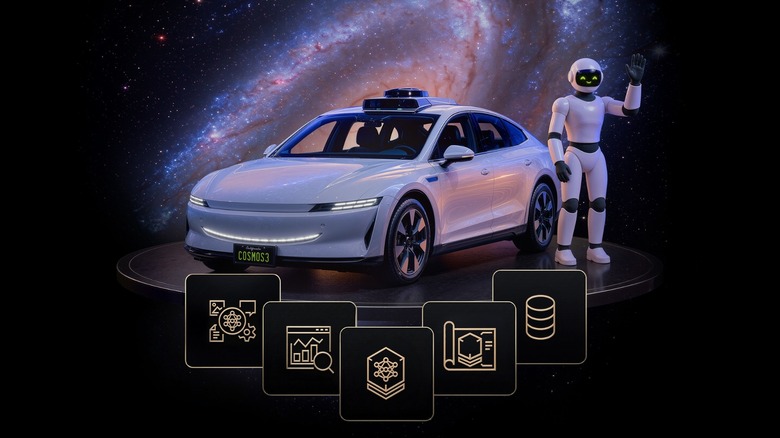
If the RTX Spark is the muscle, Nvidia Cosmos 3 is the brain. During the keynote, this was described as an open foundation model designed specifically for the physical world. Unlike a standard LLM that only understands text, Cosmos 3 is an omnimodel. It is built to take in video, depth data, tactile feedback, and sound, and turn them into motor commands.
Understanding how physical ai reasoning works requires looking at how Cosmos 3 handles the "sim-to-real" gap. By using reasoning and generation transformers, the model can predict the trajectory of a falling object or the resistance of a physical surface. This is the core of nvidia cosmos physical ai: it provides a standardized way for any machine to understand physics without being explicitly programmed for every single object it encounters.
The NVIDIA Vera Rubin AI platform provides a 10x reduction in inference token costs and a 4x reduction in the number of GPUs required to train Mixture-of-Experts models compared to the Blackwell architecture. This massive efficiency gain means that even smaller robotics startups can now afford to train their own versions of a physical ai vs embodied ai ecosystem, democratizing the future of automation.
Isaac GR00T: Democratizing Humanoid Robotics
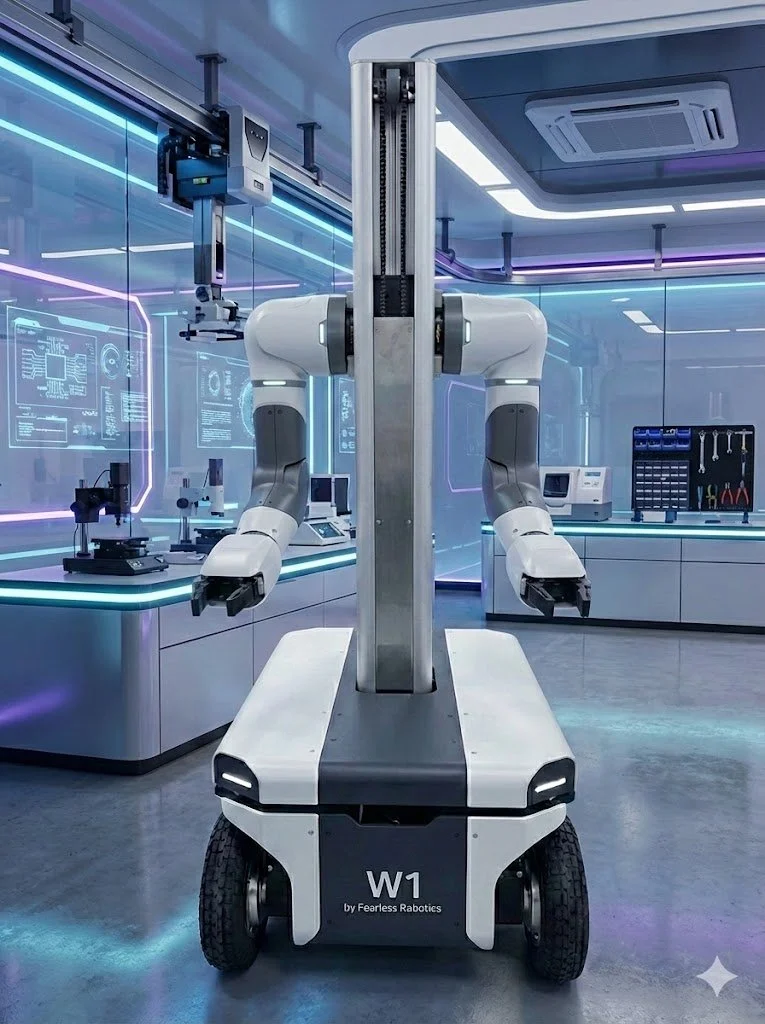
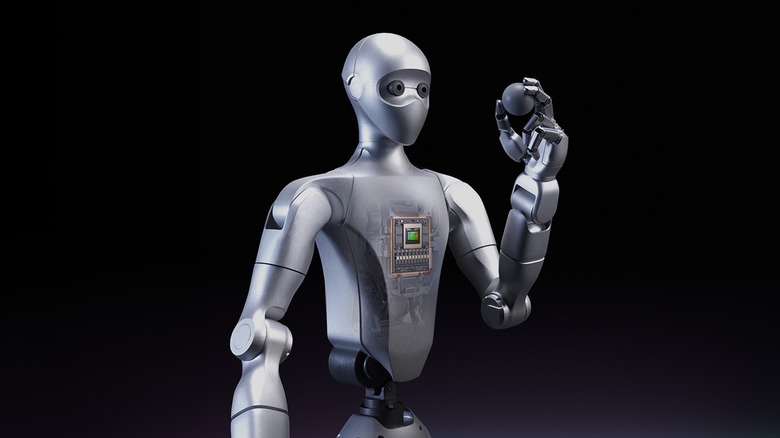
The most visually stunning part of the Computex 2026 presentation was the Isaac GR00T humanoid robot reference design. Nvidia isn't just making the chips; they are providing the blueprint for the entire robotics industry. The GR00T design combines a humanoid chassis with the Jetson Thor module, a specialized piece of silicon specifically tuned for vision-language-action tasks.
This project is a massive step in the physical ai robot space. By standardizing the hardware—including Sharpa Wave tactile hands and the Unitree H2 chassis—Nvidia is allowing developers to focus on the software. This is a classic "PC-style" move: create a standard platform and let the ecosystem innovate. The Jetson Thor module provides the real-time processing needed for a robot to walk into a house it has never seen before and perform complex tasks like folding laundry or organizing a kitchen.
| Tech Layer | New Technology | Key Specification | Real-World Benefit |
|---|---|---|---|
| Consumer Gear | RTX Spark Superchip | 70B Transistors | Privacy-focused local AI agents |
| Visual Computing | DLSS 4.5 | Neural Spatial Awareness | Better gaming and AI navigation |
| Transportation | Alpamayo 2 Super | 32B Parameter Reasoning | Human-like autonomous driving |
| Foundation Model | Cosmos 3 | Omnimodel VLA | Unified reasoning for all robots |
| Robotics Hardware | Isaac GR00T | Jetson Thor Module | Standardized humanoid development |
Hardware Requirements:
- Control Center: Nvidia Jetson Thor
- Sensory Input: Stereoscopic 4K Vision + LiDAR
- Actuators: 20+ DOF humanoid chassis
FAQ
What is a physical AI example?
A prime physical ai example is a humanoid robot like those built on the Isaac GR00T platform. Unlike a chatbot, this AI uses cameras and sensors to see a physical object, reasons about its weight and fragility using a model like Cosmos 3, and then uses motors to physically pick it up and move it. Self-driving cars using the Alpamayo 2 Super model are also prominent examples.
How is Physical AI different from AI?
Traditional AI, often called Information AI, focuses on processing digital data like text, images, or code (e.g., ChatGPT). Physical AI takes it a step further by interacting with the three-dimensional world. It requires spatial intelligence and an understanding of physics to perform actions, navigate environments, and handle objects in real-time.
What is the difference between agentic AI and physical AI?
Agentic AI refers to a software system that can take independent actions to achieve a digital goal, like booking a flight or managing an inbox. Physical AI is a subset of agentic AI that specifically operates in the real world. While all physical AI is agentic in nature, not all agentic AI has a physical body or interacts with physical matter.
What type of AI is ChatGPT?
ChatGPT is a type of Large Language Model (LLM) often categorized as Information AI. It is designed to predict the next token in a sequence of text and cannot perceive the physical world or perform motor actions. While it can "reason" about physics if you ask it a word problem, it cannot apply that reasoning to move an arm or drive a car without being integrated into a physical ai system.