Quick Facts
- Threshold: LATCH weight limits represent the maximum combined weight of a child and their car seat that a vehicle's lower anchors can safely support during a crash.
- The 65-Pound Rule: Most systems are rated for a total of 65 pounds, including the weight of the hardware itself; exceeding this can lead to anchor failure or deformation.
- 2014 Mandate: Federal regulations mandated clear weight labeling on all car seats manufactured after February 2014 to simplify the combined weight calculation for parents.
- Transition Point: You should switch to a seat belt installation once the child and car seat reach the 65-pound combined limit or the specific limit listed on your seat’s mandatory safety labels.
- The Lowest Number Rule: Caregivers must follow the most conservative limit among the car seat's specifications, the vehicle manufacturer's rating, and the federal 65-pound standard.
- Tether Priority: Even after switching to a seat belt for the lower portion of the seat, the top tether should always be used for forward-facing car seats to reduce head excursion.
- Error Rate: According to the National Digital Car Seat Check Form database, 74% of car seats inspected in 2023 were found to be improperly installed or used.
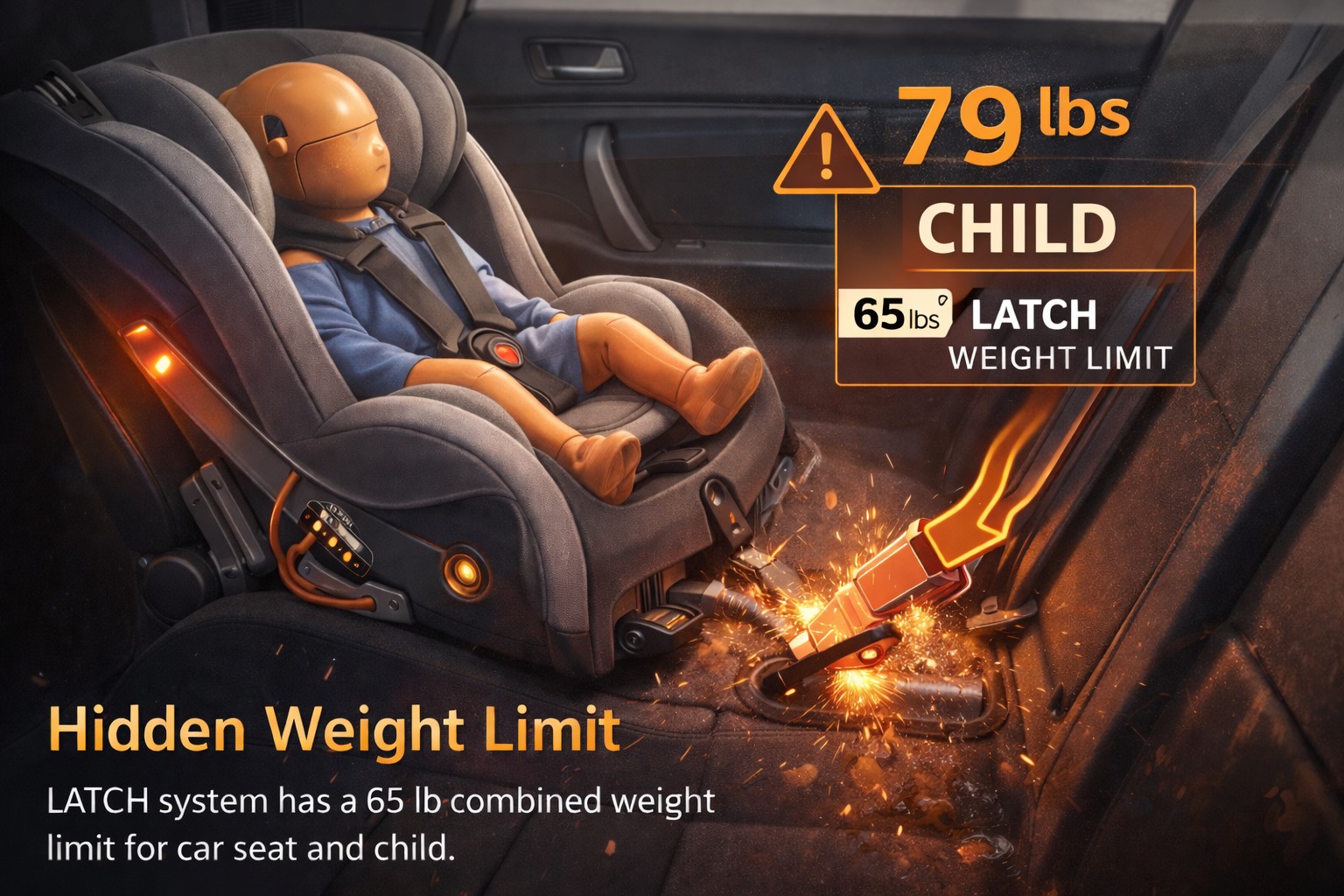
LATCH weight limits represent the maximum combined weight of a child and car seat that anchors can support. Most are rated for 65 pounds total. If exceeded, anchors can fail. Switch to a seat belt once this limit is reached. This shift ensures the structural integrity of the restraint system during the high-force event of a collision, utilizing the vehicle seat belt which is designed to hold much higher occupant loads.
The Fatal Physics: Why LATCH Weight Limits Matter
When you click those lower connectors into your vehicle’s anchors, you are relying on a system of steel and bolts to hold your most precious cargo in place during a violent event. However, many parents assume these anchors are as strong as the vehicle’s frame itself. In reality, car seat lower anchor weight limits are specifically calibrated for lower occupant weights.
During a standard 30 mph crash, the forces exerted on those small metal loops are staggering. Safety testing suggests that when a combined car seat weight limit is exceeded, the anchors may face up to 14,922 Newtons of force. At this threshold, structural failure risks become a terrifying reality. Steel anchors can actually rip out of the vehicle frame, or the connectors on the car seat itself can snap.
Even if the anchors don't fully detach, anchor deformation in crash test simulations shows that the seat can pitch forward significantly. This extra movement increases the risk of the child’s head striking the back of the front seat or the vehicle interior. The physics of impact force distribution dictate that as a child gets heavier, the lower anchors are no longer the safest method of attachment. Because a survey conducted by the AAA Foundation for Traffic Safety found that 80.5% of certified Child Passenger Safety Technicians believe LATCH installation errors are not easily noticed by parents and caregivers, understanding these limits is your first line of defense.
Warning: The Anchor Failure Threshold Vehicle lower anchors are tested to specific limits. Once the weight of the child and the seat combined passes 65 pounds, the structural integrity of the lower anchors cannot be guaranteed. At 14,922 Newtons of force, the steel may bend or the attachment points may shear, leading to a complete failure of the restraint system.
The 65-Pound Calculation and the 2014 Mandate
Before 2014, determining when to stop using the LATCH system was a confusing mess of math and manual-reading. To solve this, the National Highway Traffic Safety Administration (NHTSA) enacted a rule on February 27, 2014, requiring that caregivers stop using the LATCH system's lower anchors and switch to a seat belt installation once the combined weight of the child and the car seat exceeds 65 pounds.
This rule simplified the car seat labeling rules, requiring manufacturers to print a clear, easy-to-read label stating exactly when the lower anchors should no longer be used. However, you need to understand the formula: 65 lbs (the total limit) - The Weight of Your Car Seat = The Maximum Child Weight for LATCH.
Many modern convertible car seats are heavy, often weighing between 20 and 30 pounds due to steel frames and side-impact protection technology. If your car seat weighs 28 pounds, your child can only use LATCH until they reach 37 pounds. Because most children reach this weight between ages 3 and 5, you will likely need to perform a car seat seat belt installation long before your child is ready for a booster seat. Keeping an eye on occupant weight tracking is essential as your child grows.
| Feature | Pre-February 2014 Seats | Post-February 2014 Seats |
|---|---|---|
| Labeling Requirements | Often vague; required manual check | Mandatory clear weight limit labels |
| Standard Limit | Varied by manufacturer (40-48 lbs) | Universal 65 lbs combined limit |
| Calculation | Child weight only (usually) | Combined child + seat weight |
| Primary Safety Source | Vehicle manual was the main guide | Car seat label is the primary guide |
Audit Your Hardware: The Checklist of Three
Safety isn't just about following one rule; it’s about verifying information across multiple sources. To ensure you aren't exceeding the safety risks of exceeding car seat anchor weight limits, you must perform what technicians call a "Manual Audit." This process ensures you are applying the Lowest Number Rule—where you follow the most restrictive weight limit found in any of your documentation.
- Check the Car Seat Labels: Look for the mandatory safety label on the side or back of the seat. It will specify the maximum child weight for lower anchor use.
- Review the Car Seat Manual: Dig into the installation section. It will often provide specific guidance on how to find car seat lower anchor capacity in vehicle manual if their own limits are different.
- Consult the Vehicle Owner's Manual: Navigate to the "Child Restraint" or "Child Safety" section. Some vehicle manufacturers have lower anchor limits that are more restrictive than the car seat itself.
If your car seat says 45 pounds, but your vehicle manual says 40 pounds, you must switch to the seat belt at 40 pounds. This intersection of vehicle manufacturer ratings and NHTSA safety standards is where many parents get confused, but staying conservative is the only way to ensure 5-point harness security remains intact.
Myth Busting: Why You Should Never Use Both LATCH and Seat Belts
A common instinct among parents is that if one system is good, two must be better. They attempt a dual installation, using both the lower anchors and the vehicle seat belt simultaneously. This is a dangerous mistake.
Most car seats are designed and crash-tested to be installed with either the LATCH system or the seat belt, not both. Using both can change how the seat reacts in a crash. For instance, the seat belt and LATCH webbing are designed to stretch slightly to absorb energy. When both are used, the system becomes too rigid, transferring the full force of the impact directly to the child's body. Furthermore, the two systems may interfere with each other's paths, preventing a secure lock.
The only exception to this is when using certain booster seats. In these cases, the lower anchors are only holding the seat in place so it doesn't become a projectile when empty, while the vehicle seat belt provides the actual restraint for the child. Always consult your specific manual for latch vs seat belt installation for older children to see if your specific model allows this.
Forward-Facing Safety: The Top Tether Priority
While the lower anchors have strict weight limits, the top tether is a different story. The top tether is the strap that comes from the top of the car seat and hooks to an anchor point on the vehicle's rear shelf, seat back, or floor. Even when you transition to a seat belt installation, the top tether must remain in use for all forward-facing seats.
The top tether is the most critical component for preventing head excursion—the distance the child's head moves forward in a crash. By securing the top of the seat, it reduces forward movement by several inches, which can be the difference between a minor injury and a traumatic brain injury. Most forward-facing car seat latch weight limit guidelines focus on the lower anchors, but the tether is designed to work in conjunction with the vehicle seat belt. Always ensure your top tether usage is consistent with your vehicle's tether anchor weight limits, which are often higher than the lower anchors.
FAQ
What is the weight limit for LATCH system use?
The standard combined weight limit for the LATCH system is 65 pounds, which includes the weight of the child and the car seat hardware. However, you should always check your specific car seat labels, as some manufacturers set lower limits based on their own crash testing.
How do I find the LATCH weight limit for my car seat?
For seats manufactured after February 2014, the limit must be clearly printed on a permanent label on the side of the car seat. You can also find this information in the installation section of your car seat owner's manual or by contacting the manufacturer directly.
Does the LATCH weight limit include the weight of the car seat?
Yes, the federal 65-pound limit is a "combined weight" limit. This means you must add the weight of the child to the physical weight of the car seat to determine if you are within the safe operating range for lower anchors.
When should I switch from LATCH to a seat belt installation?
You should switch once your child reaches the maximum weight listed on the car seat's LATCH label or once the combined weight of the child and seat hits 65 pounds. For most convertible seats, this happens when the child is between 35 and 45 pounds.
Is there a separate weight limit for the top tether?
Yes, some vehicle manufacturers have specific weight limits for top tether anchors, though they are generally higher than lower anchor limits. However, safety experts and the NHTSA recommend using the top tether for all forward-facing installations, even with a seat belt, because its safety benefits in reducing head excursion are so significant.
What is the combined weight limit for a child and car seat when using LATCH?
The universal combined weight limit is 65 pounds. This was established to ensure that the force generated in a crash does not exceed the structural capacity of the vehicle's lower anchor points.
Protecting Your Progress
Switching from LATCH to a seat belt installation might feel like a step backward in convenience, but it is a massive step forward in safety as your child grows. The seat belt is an incredibly strong restraint designed to hold full-grown adults; it does not have the same restrictive weight capacities as the lower anchor system.
If you are unsure about your installation or the specific limits of your hardware, do not guess. Seek a professional safety check from a certified Child Passenger Safety Technicians. These experts are trained to spot the subtle errors that 80% of technicians say parents miss. Taking ten minutes to audit your manual and check your labels today ensures that your restraint system will perform exactly as intended if the unthinkable happens. Remember, the goal of car seat safety isn't just a tight fit—it’s a fit that respects the laws of physics.